Food · NIDO

Meet the product
What it is & how to use itPowdered whole milk for drinking and cooking — stir 2 tbsp (one scoop) into 8 oz of water.
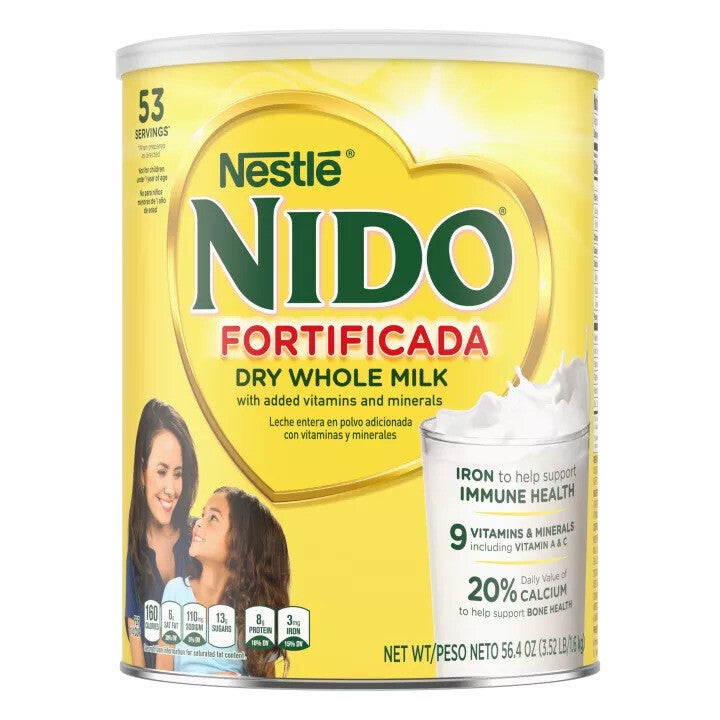
NIDO Fortificada Dry Whole Milk
This fortified powdered whole milk is sold mainly to Latino households in the US.

What it usually sells for
- Walmart
- ~$19
- Target
- ~$22
- Amazon
- ~$24
- Convenience / bodega
- ~$28
These are typical shelf prices seen across different places that sell it — not live prices.

What goes into the cost
Friendly note: every cost and margin figure here is an AI estimate for learning — not the brand's official numbers. Curiosity welcome, certainty not claimed.
- Whole milk powder (~2.2 kg)
- $8.40
- Vitamins & mineral premix
- $0.35
- Metal can + scoop + lid
- $1.40
- Processing & spray drying
- $0.95
- Freight & warehousing
- $0.90
AI estimate: we use public commodity, packaging and freight benchmarks to piece this together — not the company's own data.

Who's behind it

Nestlé S.A.
Public — Swiss multinational, world's largest food company · SIX: NESN
- Brand
- NIDO
- Market cap (Oct 2026)
- ~CHF 195B
- HQ
- Vevey, Switzerland
- Category
- Dairy & nutrition
Logos belong to their respective owners; Margin Seeker is not affiliated with or endorsed by these brands.

Ingredients & nourishment
Ingredient context, not a health score. US FDA rules below; limits vary by food and country. Amounts and compliance are not verified.
Ingredients
Whole milk
Everyday ingredientMilk with its naturally occurring fat, protein and lactose.
Milk allergy, lactose and fat content matter to some shoppers.
Permitted use / limit: No additive-use maximum for milk as a food. For standardized dry whole milk: 26% to less than 40% milkfat; moisture no more than 5% on a milk-solids-not-fat basis. These are identity rules, not a serving limit.
FDA · 21 CFR 131.147(a)Ingredients
Soy lecithin
A soy-derived emulsifier that helps ingredients blend.
Some shoppers check soy-derived ingredients and prefer fewer emulsifiers.
Permitted use / limit: No numerical maximum under this rule; use is limited to current good manufacturing practice (only what is needed for its function).
FDA · 21 CFR 184.1400(c)Ingredients
Vitamin A palmitate
A form of vitamin A used to fortify foods.
Some shoppers track added vitamins alongside other fortified foods or supplements.
Permitted use / limit: No universal food limit can be inferred here. The permitted amount depends on the food standard and vitamin form; this analysis does not verify the added amount.
FDA · 21 CFR 104.20Ingredients
Vitamin D3
A form of vitamin D used to fortify foods.
Some shoppers check the added amount alongside other vitamin sources.
Permitted use / limit: Permitted uses and amounts depend on the food category. No product-specific limit or compliance result is established by this analysis.
FDA · 21 CFR 184.1950Ingredients
Iron
A mineral added here for fortification.
Some shoppers track mineral intake from fortified foods and supplements.
Permitted use / limit: Not verified: “iron” does not identify the chemical form or amount. Fortification guidance does not set one universal permitted limit.
FDA · 21 CFR 104.20Ingredients
Zinc
A mineral added here for fortification.
Some shoppers track added minerals across their foods and supplements.
Permitted use / limit: Not verified: “zinc” does not identify the chemical form or amount. Fortification guidance does not set one universal permitted limit.
FDA · 21 CFR 104.20Ingredients
Vitamin C
Everyday ingredientA vitamin also called ascorbic acid.
Some shoppers check which vitamins are added to a food.
Permitted use / limit: Ascorbic acid as a nutrient: good manufacturing practice, with no numerical maximum in this rule. The label must identify the actual form for this rule to apply.
FDA · 21 CFR 182.8013- Per serving (28 g)
- ~150 kcal · 8 g protein · 8 g fat
- Fortification
- Iron, zinc, vitamins A, C, D
- Shelf life
- ~12–18 months sealed
A serving comes to roughly $0.26–$0.38 — less than fresh whole milk in many markets.

What people think
Across the web
4.5 / 5
537 reviews · Aggregated retailer reviews
Here on Margin Seeker

No ratings here yet — yours could be the first.
Your rating

So, is it worth it?
Most of your money goes toward actual milk. Milk powder is a commodity, so Nestlé makes a thinner margin here than on snacks; trust and fortification are what earn the brand its premium. It’s good value per serving, with the bigger markup showing up at the bodega.